WOMEN’S INTERNATIONAL PEACE CENTRE
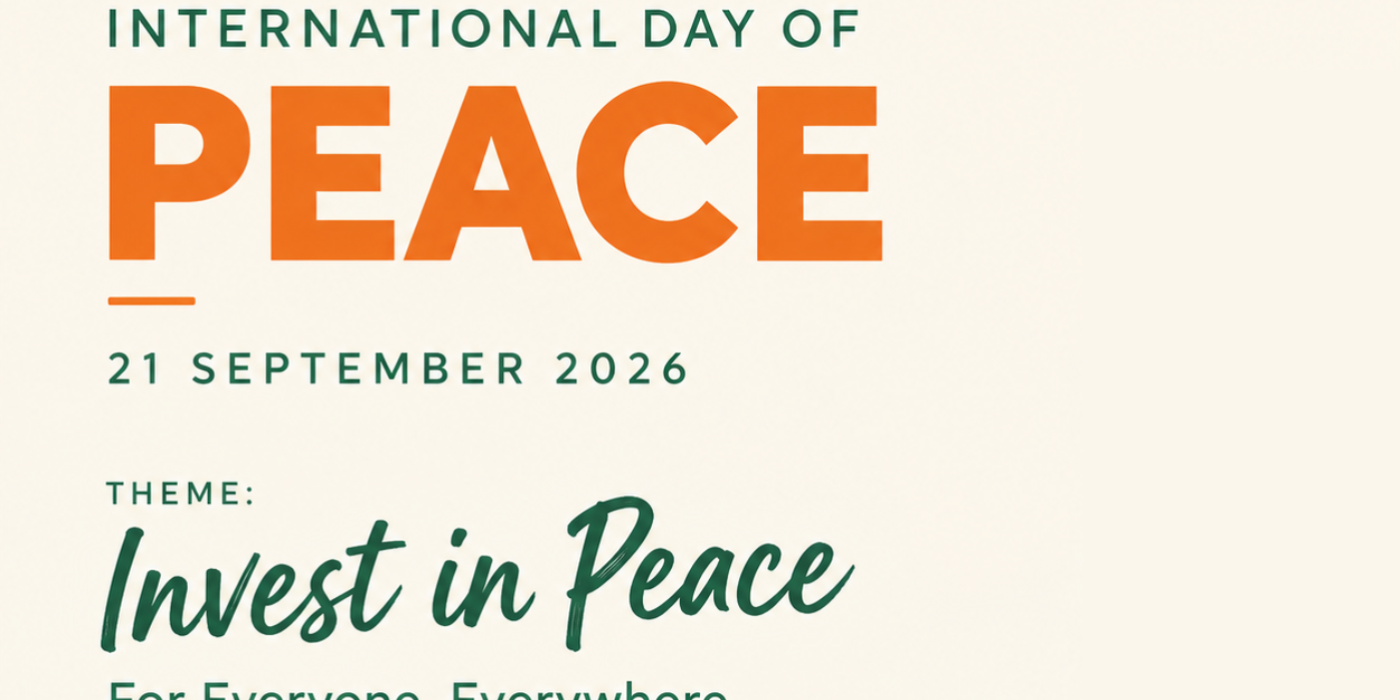
STATEMENT ON THE INTERNATIONAL DAY OF PEACE 2026
“Invest in Peace – For Everyone, Everywhere, Every Day”
Today, the Women’s International Peace Centre joins the global community in marking the International Day of Peace, established by the UN General Assembly in 1981 as a day of global ceasefire and non-violence. This year’s theme is a reminder that peace is not a single event; it is sustained through daily investment in people, institutions and communities.
The Great Lakes region has some of Africa’s most developed peace architecture: the Pact on Security, Stability and Development in the Great Lakes Region (2006), the Protocol on the Prevention and Suppression of Sexual Violence Against Women and Children (2006), and the Kampala Declaration on Sexual and Gender-Based Violence (2011), all under the International Conference on the Great Lakes Region (ICGLR). At continental level, the African Union’s Maputo Protocol, ratified by 44 of 55 member states, guarantees comprehensive rights for women. At the same time, FemWise-Africa and the AU’s Continental Results Framework exist specifically to advance women’s role in mediation and peacebuilding. The Great Lakes was among the first regions to adopt its own Regional Action Plan under this framework. These instruments are fundamental to Africa’s peace and security situation. But across the region, implementation consistently lags.
A region under compounding strain
The Great Lakes region is facing several conflicts, overlapping and reinforcing one another, with women, girls and displaced families bearing the heaviest burden.
In eastern DRC, the M23 conflict continues alongside active diplomacy: the DRC and Rwanda governments signed the Washington Accords for Peace and Prosperity in December 2025, and the DRC and the Congo River Alliance/M23 signed the Doha Framework for Peace in November 2025, with technical talks continuing through Geneva as recently as this month. More than a year on, key obligations remain unmet, and displacement inside the DRC now exceeds seven million people. In South Sudan, the 2018 Revitalized Peace Agreement remains fragile eight years on; implementation of core benchmarks, including security-sector reform and the formation of unified forces, is badly behind schedule, and continued fighting in Upper Nile and Jonglei states keeps displacing communities ahead of elections scheduled for December 2026. Sudan’s war between the Sudanese Armed Forces and the Rapid Support Forces, now in its fourth year, has produced the world’s largest displacement crisis with an estimated 11 to 12 million people displaced, millions of whom have crossed into South Sudan, Uganda, the Central African Republic, Chad and beyond. Uganda, Tanzania, Kenya and Zambia, among the world’s largest refugee-hosting nations, carry this weight even as humanitarian funding shrinks.
This is not the failure of any single state, but a regional pattern: peace agreements are negotiated and signed, yet the technical work required to sustain them including disarmament and demobilisation, reintegration of ex-combatants, resourcing for survivors of sexual violence, and the safe, dignified return of displaced populations, remains consistently underfunded. Women and girls bear the disproportionate cost of this gap. They constitute the majority of those displaced, face elevated risk of sexual and gender-based violence in conflict and displacement settings, and remain largely excluded from the decisions that concern their security.
Investing in peace means investing in women’s leadership
Despite the frameworks already in place, women’s participation in the region’s active peace processes, including the DRC-Rwanda and DRC-M23 negotiation tracks, remains limited, and the mediation and advisory structures meant to close this gap continue to operate with far less funding than the diplomatic processes they are meant to complement.
The Women’s International Peace Centre’s own record speaks to what sustained investment in women’s leadership can produce. Since 1974, we have documented women’s experiences of armed conflict across 27 countries, including Burundi, the DRC, Rwanda, South Sudan and Uganda, and built the leadership of over 20,000 women through our Feminist Leadership Institute, several of whom now hold elected and appointed government positions, including in South Sudan. This is the case for investment: where women’s leadership has been resourced, it has translated into influence over the decisions that affect their communities. The gap is not evidence of what works — it is evidence of what remains underfunded.
Our call to Action
On this International Day of Peace, we call on Great Lakes governments, the African Union, the ICGLR and international partners to:
- Fund implementation — resource the outstanding provisions of regional peace agreements, including humanitarian access, disarmament and the return of displaced persons, on monitored timelines.
- Operationalise the Kampala Declaration and SGBV Protocol — with real budgets for survivor support and functioning special courts.
- Meet the AU’s 30% quota for women’s participation in peace processes, and properly resource FemWise-Africa and the Great Lakes WPS Advisory Board.
- Complete universal ratification of the Maputo Protocol and enforce it in national law.
- Fund local peacebuilders directly — the community mediators and survivor-led organisations rarely at the negotiating table but essential to social cohesion.
Investing in women is not a parallel commitment to peace — it is the condition for peace to hold. Women make up the majority of those displaced by the region’s conflicts, are disproportionately exposed to violence within them, and are consistently the ones sustaining community cohesion once the fighting subsides — yet remain the most underfunded and underrepresented actors in the processes meant to resolve them. Correcting that imbalance is not an act of inclusion for its own sake; it is what determines whether peace, once negotiated, actually lasts. This International Day of Peace, that is the investment we call for: sustained, funded, and directed toward the women and communities carrying peace forward every day, everywhere.