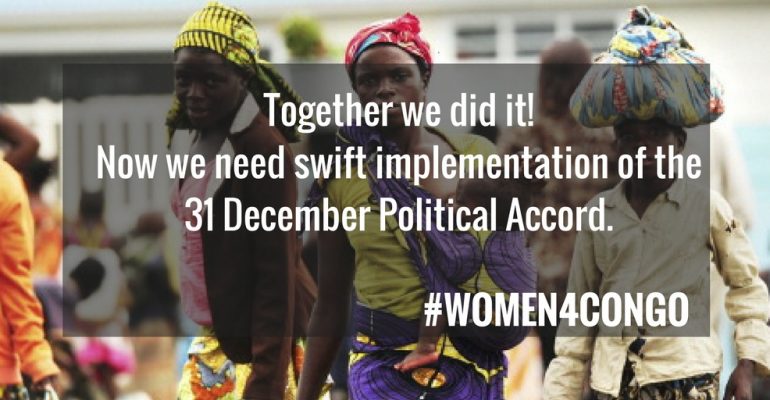
Some 50 women’s organizations from the DRC, Africa and the rest of the world call on President Kabila and other political actors to swiftly implement the 31 December agreement. (Full list of signatories and recipients below)
Dear All Parties to the 31st December Political Accord,
We, the undersigned women of the
Democratic Republic of Congo, Africa and across the world, welcome the
Global and Inclusive Political Accord of the Centre Interdiocésain de
Kinshasa, reached on the 31st
of December 2016. We congratulate each of you as signatories for
choosing peace over conflict. This agreement represents an important
step towards ensuring a peaceful future for DRC, though to do so, it is
vital that parties work together to translate the agreement into
tangible progress on the ground.
In a previous letter addressed to President Kabila on December 15th
2016, we stressed two urgent demands: first, that President Kabila
state publicly he will not run for a third term as Head of State; and
second, that he not support any amendments to the Constitution. We are
very pleased to see that that these two asks have been met and are
specifically mentioned in the agreement of the 31st December.
We now ask for all parties to the agreement to ensure two things:
1) To fully implement the Accord,
including by swiftly finalising an electoral schedule to ensure that
elections are held before the end of 2017.
2) To ensure that civil society, in
particular women, have a significant role in the follow-up mechanism for
the peace agreement (‘Conseil national pour le suivi de l’accord.’)
We call upon our sisters and brothers
across Africa and the international community to support your
leadership and efforts towards a successful implementation of the
agreement. We warmly welcome the response to the agreement by the
Chairperson of the African Union Commission, and the United Nations
Security Council Presidential Statement. However we believe it is
ultimately Congolese leaders who can prioritize peace and bring
stability to the nation.
We express our gratitude to CENCO for
their role in this agreement being reached, and urge CENCO to continue
working with all sides to ensure the accords’ full implementation.
As signatories to the political
Accord, the world is watching you. We are watching you and remind you
that the security of the Democratic Republic of Congo is in your hands.
We urge you to use the political gains that you have secured with the
global inclusive accord to achieve the first ever peaceful and
democratic transition of power in the history of the DRC, and to pave
the way for lasting peace.
Please accept the assurances of our highest consideration.
Signed:
Women’s Organisations from the Democratic Republic of Congo:
- Action des Femmes pour le Développement (AFD)
- Action pour la Paix et la Protection de l’Enfant (APPE)
- Action pour la Protection des Droits Humains et de Développement Communautaire (APDHUD)
- Agir pour la Reconstruction de notre espace et la convivialité (AGIREC)
- Association pour le Développement des Initiatives Paysannes (ASSODIP)
- Association de défense des Droits de la Femme (ADDF)
- Association des Femmes Juristes Congolaises Représentation du Maniema (AFEJUCO/MMA)
- Centre de Promotion Socio- Sanitaire (CEPROSSAN ASBL)
- Centre d’Observation des Droits de l’homme et d’Assistance Sociale
- Cercle internationale Pour la Défense des Droits de l’Homme, la paix et l’Environnement (CIDDHOPE)
- Convention Pour le Respect des Droits de l’Homme (CRDH)
- Femmes Agissons pour la Paix (FAP)
- Femmes Engagées pour la Promotion de la Santé Intégrale (FEPSI
- Femmes Juristes pour la défense des Droits de la Femme (FJDF)
- Femmes Solidaires pour la Paix et le Développement (FSPD)
- Great Lakes Human Right Program (GLHRP)
- Groupe d’Associations de Défense des Droits de l’Homme et de Paix (GADHOP)
- Mama Tupendane (MTP)
- Mama Tushirikiane (MATU)
- Maniema Libertés (MALI)
- Maniema Yuende Mbele (MTM)
- Mini Réseau de Plaidoyer de Protection/Butembo
- Observatoire de la Dépense Publique (ODEP)
- Pax Christi Butembo
- Réseau des Para-juristes du Maniema (REPAJUMA)
- Solidarité des Associations Féminines pour les Droits de Femmes et de l’Enfant (SAFDF)
- UCOOFADE
- Union des Femmes pour le Développement (UFD)
- Wanama Tusimame
International Organisations :
- Akina Mama wa Afrika, Uganda
- Eastern African Sub-Regional Support Initiative for the Advancement of Women (EASSI), Uganda
- Fahamu, Kenya
- Gender Empowerment for Sudan Organization (GESO), South Sudan
- Inspiring Africa, Zimbabwe
- Isis-Women’s International Cross-Cultural Exchange (ISIS-WICCE), Uganda
- Mouvement des Femmes Filles pour la Paix et la Sécurité au Burundi (MFFPS), Canada
- Never Again Coalition, United States of America
- People Opposing Women Abuse (POWA), South Africa
- People’s Empowerment Foundation (PEF), Thailand
- Regional Associates for Community Initiatives (RACI), Uganda
- Rural Women and Youth Fund, Uganda
- South Sudan Women’s Empowerment Network (SSWEN), South Sudan
- Strategic Initiative for women in the Horn of Africa Network (SIHA Network), Horn of Africa region
- Swaziland Rural Women’s Assembly, Swaziland
- Uganda Women Writers’ Association (FEMRITE), Uganda
- Women’s International League for Peace and Freedom (WILPF), United Kingdom of Great Britain
- Women and Girls for Peace and Security in Burundi, United States of America
_________________
Letter addressed to:
H.E. Joseph Kabila
President of the Democratic Republic of Congo
All parties to the Political Accord of the 31st December 2016:
Majorité présidentielle
Opposition républicaine
Opposition politique
Rassemblement des forces politiques et sociales
Front pour le Respect de la Constitution
Parti travailliste
Société civile
CC :
African Union Commissioner for Peace and Security;
Conférence Nationale Episcopale du Congo
European Union Managing Director for Africa
Southern Africa Development Community Executive Secretary
Head of United Nations Organization Stabilization Mission in the DR Congo (MONUSCO)
International Conference of the Great Lakes Region Executive Secretary representative
International Organization of the Francophonie Special Envoy
United Nations Special Envoy for the Great Lakes region